

Paying for a fit-out in Malta: deposits and stage payments
Malta has no payment legislation written for construction. What governs your fit-out is the Civil Code's contract of works, the unfair terms rules in the Consumer Affairs Act, and whatever your contract actually says — which makes the wording of your payment schedule the thing that matters most.
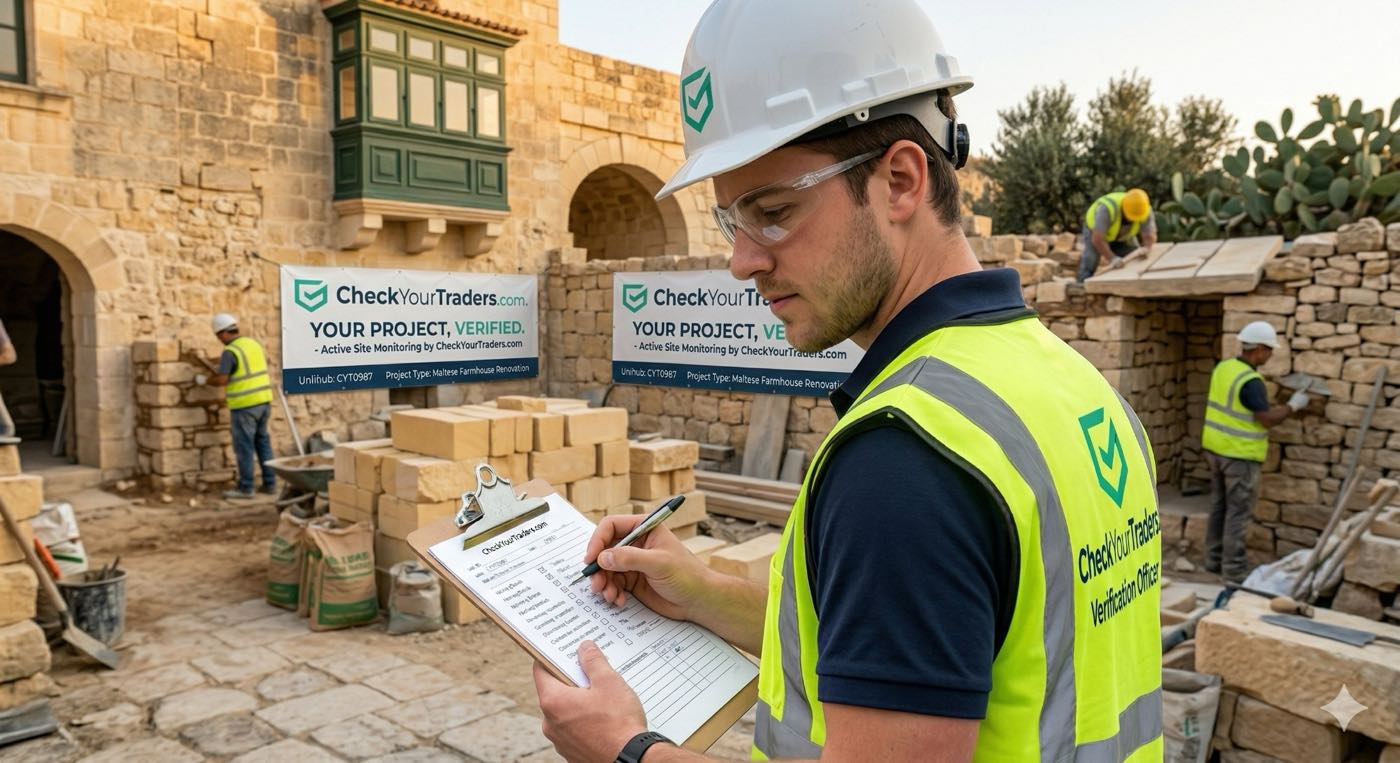
Most people buying in Malta buy a shell: blockwork, a screed if you are lucky, service points stubbed off, nothing else. The fit-out that turns it into a flat is a separate contract with a separate contractor, and the first serious decision you make is not the kitchen. It is the payment schedule.
Buyers arriving from the UK or elsewhere in the EU tend to assume there is a construction payment statute underneath all this — something that fixes due dates, bars pay-when-paid clauses and gives you an adjudicator when a stage payment is disputed. There is not. A 2026 practitioner survey of Maltese construction law states plainly that Malta has no construction-specific payment legislation. What you have instead is the Civil Code's contract of works, the general consumer rules, and your own contract.
The Civil Code is the default, and it is thin
A fit-out is a locatio operis — a contract of works, governed by arts 1623-1643 of the Civil Code (Cap. 16).
Two provisions matter before you sign anything.
Art. 1624 says that if the price is not fixed in the agreement, or by law or custom, the court fixes it, with or without an expert valuation. That is the fallback, and it is a bad one: it means a dispute over an unpriced variation ends with a judge and possibly a court-appointed expert deciding what your bathroom was worth. Price everything in writing, including variations, as they arise.
Art. 1637 governs work done in pieces or by measure — which is what a fit-out is. Sub-article (1): the risk stays with the contractor until the employer examines the whole, unless the contract provides for piece-by-piece examination. Sub-article (2): pieces that have been paid for are presumed examined if the employer pays in proportion to the work done. Sub-article (3): that presumption does not arise where stage payments are made on account of the whole job without being tied to a specific piece.
Read those together and the practical rule falls out. A payment schedule tied to defined stages is the right structure for controlling a job — but the moment you pay against a defined stage, you may be taken to have examined it. The protection is not to pay vaguely. It is to inspect first and pay second, every time, and to record what you inspected.
Deposits: the 10% cap, and why it may not reach you
There is one hard number in Maltese consumer law. Reg. 11 of the Consumer Rights Regulations (S.L. 378.17) — a Malta-specific provision, last amended by L.N. 145 of 2026 — says that in an off-premises contract the trader may not ask for payment before delivery of the goods, except a deposit of up to 10% of the price of the goods, payable no earlier than 14 days after the contract.
"Off-premises" is the relevant category because fit-out contracts are routinely signed in the client's flat. The same regulations give a 14-day withdrawal right for distance and off-premises contracts, extended to 30 days after an unsolicited home visit.
Now the honest part. The scope exclusions in those regulations cover contracts for the construction of new buildings, the substantial conversion of existing buildings, and residential rentals. A full fit-out of a shell plausibly sits inside "substantial conversion" — and reg. 11 is framed around the price of goods, not works. Whether your fit-out is caught or excluded is a legal reading we could not confirm from the sources, and we are not going to pretend otherwise. If a contractor asks for a large up-front payment on a contract signed in your home and you want to challenge it, that question needs a lawyer or the MCCAA.
As for what a deposit normally is on a Maltese residential fit-out: nobody publishes it. We could not find a reputable Maltese source giving typical deposit percentages or milestone patterns for homes. Any percentage you are quoted is a negotiating position.
Retention and guarantees — real, but from the big end of the market
The figures that do exist in print come from the medium and large project world:
| Mechanism | Stated range | Where it is used |
|---|---|---|
| First-demand performance guarantee | 4-10% of contract price | Medium and large projects |
| Advance-payment guarantee | held until the advance is repaid | Medium and large projects |
| Retention from interim payments | generally 5-10% | Medium and large projects |
Retention is described as typical, deducted from interim payments and released in one or two tranches at completion and/or at the end of the defects period. Liquidated delay damages are also described as common. None of this is law; it is practice, and it is practice on jobs considerably larger than a two-bedroom apartment. Whether a residential client can get retention into a fit-out contract is a matter of negotiation, but the mechanism is a known one in the market and asking for it is not exotic.
Note also what does not apply to you: the Commercial Code's late payment regime — payment due 30 days from invoice unless agreed, with agreed periods capped at 60 days unless expressly agreed and not grossly unfair — operates between businesses. As a consumer client you are outside it.
Unfair terms are unlawful, including payment terms
Art. 44(1) of the Consumer Affairs Act (Cap. 378) makes unfair terms in consumer contracts unlawful and treats them as never written. Art. 46 keeps the rest of the contract alive without the offending term where that is possible.
The listed examples in art. 44(2) map directly onto the payment clauses you will be shown:
- (f) letting the trader keep sums you have paid if you withdraw, without equivalent compensation when the trader is the one who cancels;
- (g) a disproportionately high sum demanded from a consumer who defaults;
- (n)/(o) unilateral changes to the terms, or to the service itself, without a valid reason;
- (p)/(q) price increases with no right to cancel, or prices varied at the trader's will;
- (x) the trader alone setting or altering delivery periods.
A clause saying the contractor may revise the price to reflect material costs, with no corresponding exit for you, is squarely in (p)/(q) territory. A forfeit-the-whole-deposit clause is in (f) territory. Being unlawful is not the same as being refunded, but it changes who is in trouble.
If it comes to a claim, art. 20(1) gives the Consumer Claims Tribunal jurisdiction over consumer claims against traders for services up to EUR10,000.
If you stop the job
Art. 1640 is the escape hatch, and it cuts both ways. The employer may dissolve the contract at any time, with immediate effect on notice given by any means. Dissolve it without a valid reason and you pay expenses and work done plus up to the lost profit. Dissolve it with a valid reason and you pay no more than expenses and work, taking into account their usefulness and your own damages. Art. 1640(4) is the one to remember when a contractor is sitting on your money: any advance is set against what is due, and the contractor must return any excess.
One related exposure. Under art. 1643, workers employed by the contractor can claim from the owner only up to what the owner still owes the contractor. If you are fully paid up and the contractor has not paid his men, you are not the backstop. If you are sitting on a large unpaid balance, you may be.
A payment schedule that holds up
Nothing above gives you a statutory milestone pattern, because none exists. What the sources do support is a structure:
- Fix the price in writing, including the rate or method for variations, so art. 1624 never has to be used.
- Keep the up-front payment small and justified — against ordered materials or a mobilisation cost you can see — rather than a round percentage of the whole.
- Define each stage as a finished, inspectable thing: first fix complete and tested, plastering complete, apertures installed and operating. Not "60% complete".
- Inspect before releasing, and note what was inspected. Art. 1637(2) means payment can be read as examination.
- Hold a retention and say when each tranche is released — at completion, and at the end of a stated defects period.
- Write the cancellation terms symmetrically. Asymmetric forfeiture is exactly what art. 44(2)(f) targets.
Add the Malta-specific friction to your staging, because it moves dates and therefore payments: Planning Authority permits where the works need them, condominium rules and common-part access in a block, and — for anything in Gozo — a ferry crossing behind every delivery. None of those are legal grounds for a payment, but all of them are reasons a stage slips. Tie money to finished work, not to the calendar, and the slippage stays the contractor's problem rather than yours.
Common questions
- Is there a legal cap on the deposit a fit-out contractor can ask for?
- There is a 10% cap, but it is narrow. Reg. 11 of S.L. 378.17 says that in an off-premises contract the trader may not ask for payment before delivery of the goods, except a deposit of up to 10% of the price of the goods, payable no earlier than 14 days after the contract. That rule is Malta-specific, it refers to the price of goods, and the regulations' scope exclusions cover contracts for the construction of new buildings and the substantial conversion of existing buildings. Whether a shell-form fit-out counts as substantial conversion, and whether a deposit cap framed around goods reaches a works contract, is a legal reading we could not confirm. Outside that rule there is no statutory ceiling.
- What is a normal deposit percentage for a residential fit-out in Malta?
- No reputable Maltese source we could find publishes typical residential fit-out deposit percentages or milestone patterns. The figures that do exist in print — performance guarantees of 4-10% of contract price and retention of 5-10% — come from a practitioner guide describing medium and large projects, not flats. Treat any percentage you are quoted as a negotiating position, not a standard.
- If I pay for a stage, have I accepted it?
- Possibly. Under art. 1637(1) of the Civil Code, where work is done in pieces or by measure the risk stays with the contractor until the employer examines the whole, unless the contract provides for piece-by-piece examination. Art. 1637(2) then says that pieces which have been paid for are presumed examined if the employer pays in proportion to the work done. Art. 1637(3) removes that presumption where payments are made on account of the whole job without being tied to a specific piece. So paying against a defined stage can carry an inference that you inspected it. Inspect before you pay, not after.
- Can I cancel a fit-out contract partway through?
- Yes. Art. 1640 lets the employer dissolve the contract at any time, with immediate effect on notice given by any means. Without a valid reason you pay expenses and work done plus up to the lost profit. With a valid reason you pay no more than expenses and work, taking into account their usefulness and your own damages. Art. 1640(4) says any advance is set against what is due and the contractor must return any excess.
- Where do I go if the dispute is about money?
- Art. 20(1) of the Consumer Affairs Act gives the Consumer Claims Tribunal jurisdiction over consumer claims against traders for services up to EUR10,000. Above that figure you are in the ordinary courts.
What we could not establish
- No MCCAA guidance specific to deposits or quotations for home improvement or fit-out work was found; mccaa.org.mt pages were not loaded for this article.
- No reputable Malta source gives typical residential fit-out deposit percentages or milestone patterns. The 4-10% guarantee and 5-10% retention figures are stated for medium and large projects.
- Whether a shell-form fit-out amounts to 'substantial conversion of an existing building' (and so falls outside S.L. 378.17), and whether the reg. 11 10% deposit cap — which is framed around the price of goods — reaches a fit-out signed at the client's home, is a legal reading we could not confirm. That needs a lawyer or the MCCAA.
- There is no statutory 'payment on acceptance' rule for works in Malta. Arts 1637(2)-(3) are the closest hook in the Civil Code.
- The Commercial Code late payment regime (arts 26A-26J) applies between businesses and not to consumer clients. The Commercial Code itself was not read for this article; the source is a practitioner summary.
Sources
- Civil Code (Cap. 16), arts 1623-1643 Contract of works (locatio operis) — Government of Malta / legislation.mt · read 2026-10-26
- Consumer Affairs Act (Cap. 378), arts 20, 44-46 (unfair terms, Consumer Claims Tribunal) — Government of Malta / legislation.mt · read 2026-10-26
- Consumer Rights Regulations (S.L. 378.17) — Government of Malta / legislation.mt · read 2026-10-26
- Construction: Malta, Legal 500 Country Comparative Guides 2026 — Ganado Advocates (Cremona, Mifsud Bonnici, Farrugia) / Legalease · read 2026-10-26
Drafted with Claude — claude-opus-5, then read, corrected and approved by Neil Bennett before publication. We do not publish anything a person has not read.
Want this costed properly?
The calculator gives you a budget in a minute. A survey gives you a fixed price.
Book a free survey