

Hidden costs in a Malta fit-out: what a quote usually leaves out
A fit-out quote in Malta rarely covers everything you will pay before the flat is habitable. Here are the costs that sit outside it, with the rates the regulators actually publish — and an honest list of the ones nobody publishes at all.
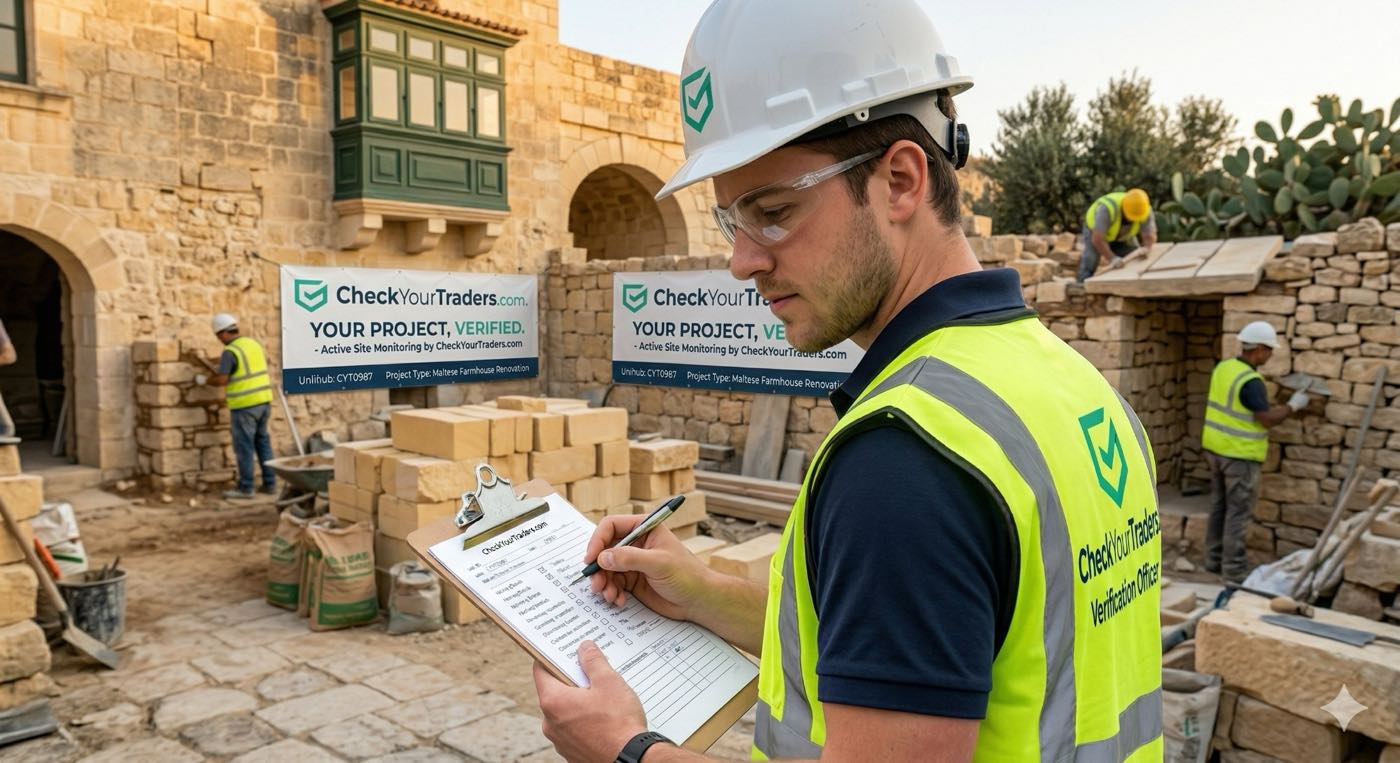
Most people buying in Malta buy a shell: bare blockwork, no screed, no plaster, no services beyond a stub. The fit-out quote you then collect is a quote for works. It is not a quote for everything standing between you and a habitable flat. The gap between those two things is where budgets fail, and it is almost always made of the same half-dozen items.
None of what follows is a surprise to the trade. It is simply not usually written down for the buyer.
VAT at 18%, with no builder's exception
Buyers from the UK, Ireland, France or Italy often arrive expecting some reduced rate for residential renovation. Malta does not have one.
Article 19(1) of the Value Added Tax Act (Cap. 406) sets the standard rate at 18% of the taxable value. Article 19(2) allows a lower rate — anywhere from 5% to 18% — only for supplies listed in the Eighth Schedule. Construction, renovation and finishing works do not appear in that Schedule. The Schedule does carry genuinely reduced items; the minor repair of bicycles and shoes sits at 5%, which gives you a sense of how narrowly it is drawn. Building work is not in that company.
So the practical question to ask of any quote is not whether VAT applies but whether the number you are reading already includes it. On a six-figure fit-out, the difference between an inclusive and an exclusive figure is a meaningful fraction of a kitchen.
Getting services to the building
A shell may have no live supply. Connection charges are regulatory, not negotiable with your contractor, and they are not normally inside a fit-out quote.
Electricity. Under reg. 14 of the Electricity Supply Regulations, as published by REWS:
| Case | Charge |
|---|---|
| Single-phase up to 40 A, within 150 m of a suitable LV supply | EUR300 |
| Three-phase up to 60 A per phase, within 150 m | EUR900 |
| Beyond 150 m, single-phase | Full extension cost less the base fee, minimum EUR430 |
| Beyond 150 m, three-phase | Full extension cost less the base fee, minimum EUR1,300 |
| Bulk supply above 60 A per phase | HV contribution of EUR81.52 per kVA |
Where amps multiplied by distance exceeds 30,000, a new substation is required rather than a contribution. Temporary supplies — the builder's supply during works — need a written application to ARMS.
Water. Under the Water Supply Regulations, REWS publishes EUR345 for one residential service connection and EUR760 for any other supply, plus EUR23.29 per metre, or part of a metre, where the service run exceeds 7 m. That per-metre charge is the one that catches out buyers of ground-floor shells set back from the street. WSC and ARMS also require additional documents with a new-connection application.
Both REWS pages were last updated on 8 October 2025.
Waste: the carrier, and the paperwork
Stripping a shell generates rubble, and since 2023 the handling of it is regulated in a way that changes who can move it.
The Construction and Demolition Waste Framework Regulations, 2023 (L.N. 311 of 2023), made under the Environment Protection Act (Cap. 549), require under reg. 5(2) that site actors prevent waste, prioritise re-use of clean excavated material, separate waste at source where the site allows it, use only an authorised waste carrier for collection and transport, and obtain documentary proof from that carrier that the waste reached an authorised facility. Regulation 6 requires the contractor to attempt separation of mineral, metal, glass, wood and plastic fractions at source, and forbids re-mixing what has been separated.
Regulation 5(4), in force from 1 January 2026, adds a pre-demolition audit requirement, but only for major applications or those of 16 units or more. A single apartment fit-out does not trigger it.
What the regulations do not do is set a price. There are no gate-fee figures anywhere in the instrument. Ask your contractor who the authorised carrier is, where the waste is going, and whether disposal is inside the quoted figure or passed through at cost.
The street outside is not part of your property
A skip, scaffolding, a lifter or a ready-mix truck occupying the road needs a local council permit. Fees are set council by council. As one undated example, Mgarr Local Council publishes:
- Skip: EUR1.16 per day
- Scaffolding: EUR2.33 per square metre per day
- Machinery under 10 m² (lifter, tower ladder): EUR10
- Machinery over 10 m² (crane, ready-mix truck): EUR15
Applications are made in person up to three days ahead, or online through the Local Permits System at localpermits.gov.mt. Treat those numbers as an illustration of scale, not as your council's tariff. Note also that the permit fee is for occupying the road — hiring the skip is a separate commercial cost.
Perit fees
Your perit is engaged by you, not by the contractor, and the fee is a separate line in your budget. Per the Kamra tal-Periti directive of 23 May 2018, the default fee scale is Tariff K in the Code of Organisation and Civil Procedure. Under reg. 20(a) of Tariff K, perit and client may agree a different fee or a different basis for calculating it, and reg. 20(b) requires that agreement to be in writing. The perit must tell you the fee, or how it will be worked out, before providing the service.
Two things follow. Get it in writing before works start, because otherwise the default scale is what applies. And note that the Kamra does not arbitrate fee disputes, so there is no cheap backstop if you leave it vague.
Condominium charges and insurance
If you are fitting out an apartment, works touch common parts: the stairwell your materials travel through, the shaft your services run in, the roof your plant may sit on. Condominium rules govern access, hours and reinstatement, and there is usually a cost-sharing dimension. The sources used for this article do not set out those rules or any figures, so nothing is quoted here — but ask the administrator in writing before you commit to a programme, not after.
Insurance is the same category of cost: real, legally relevant, and not something for which any premium figures are published that we could source. Budget for it as an unknown rather than assuming your contractor's cover extends to your property.
Reading a quote properly
Before you compare two quotes, check each one for:
- Whether figures are VAT-inclusive or exclusive at 18%.
- Whether utility connection fees are inside or outside.
- Who is the authorised waste carrier, and who pays for disposal.
- Whether council permits for skips, scaffolding and machinery are included, and for how many days.
- Whether the perit fee is yours separately — it almost certainly is.
An itemised quote lets you answer those five questions in a minute. A single lump sum does not, which is the main argument for insisting on the former. The budget calculator on our homepage exists to give you a works figure; the items on this page are the ones that sit around it.
Common questions
- Is there a reduced VAT rate for renovation work in Malta, as there is in some other EU states?
- No. Article 19(1) of the VAT Act sets the standard rate at 18% of taxable value, and article 19(2) allows a lower rate only for supplies listed in the Eighth Schedule. Construction, renovation and finishing works are not in that Schedule, so fit-out services are taxed at 18%.
- How much does it cost to connect electricity to a shell property?
- REWS publishes EUR300 for a single-phase connection up to 40 A where the property is within 150 m of a suitable low-voltage supply, and EUR900 for three-phase up to 60 A per phase on the same distance basis. Beyond 150 m you pay the full extension cost less the base fee, with a minimum of EUR430 single-phase or EUR1,300 three-phase. Above 60 A per phase a high-voltage contribution of EUR81.52 per kVA applies, or a new substation if amps multiplied by distance exceeds 30,000.
- Can my contractor just hire a skip and take the rubble away?
- Not freely. Under L.N. 311 of 2023, collection and transport must be done by an authorised waste carrier, and you must obtain documentary proof from that carrier that the waste reached an authorised facility. The contractor must also try to separate mineral, metal, glass, wood and plastic fractions at source and must not mix waste that has been separated.
- Does a perit have to tell me the fee in advance?
- Yes. Under the Kamra tal-Periti directive on fees, the perit must tell you the fee, or how it will be worked out, before providing the service. The default scale is Tariff K in the Code of Organisation and Civil Procedure; a different fee or fee basis may be agreed, but reg. 20(b) of Tariff K requires that agreement to be in writing.
- Do I need a permit to put a skip or scaffolding on the street?
- Yes, from the local council. As an undated example, Mgarr Local Council charges EUR1.16 per day for a skip and EUR2.33 per square metre per day for scaffolding, with applications made in person up to three days ahead or online through the Local Permits System. Other councils set their own fees.
What we could not establish
- No current WSC or ARMS fee schedule could be loaded directly (both the WSC and servizz.gov.mt temporary-supply pages returned 403), so the REWS figures are the only published water and electricity connection rates used here.
- Whether a temporary building-site water supply is charged at the EUR760 'any other supply' rate is not established by the sources; that figure is published by REWS for supplies other than a single residential service connection, without a site-specific breakdown.
- No published per-tonne gate fee for inert construction and demolition waste was found. L.N. 311 of 2023 contains no gate-fee figures at all, and disposal pricing is not set out in any source available here.
- Skip-hire market prices are not sourced. The council permit fee is for occupying the road; the hire of the skip itself is a separate commercial charge with no published tariff.
- The national local-council fee schedule PDF returned 403. The Mgarr figures are one council's example, the page is undated, and fees elsewhere may differ.
- Transport Malta road-works and obstruction permit fees (S.L. 499.57) could not be loaded, so works affecting a road beyond a council's remit are not costed here.
- The reported VAT refund on restoration works could not be confirmed from an official source and is deliberately not stated in this article.
- The Tariff K percentages themselves were not loaded, and typical market perit fees for a fit-out are not published anywhere we could source.
- Typical home and fit-out insurance premiums are not sourced; no figures are given.
- Delivery surcharges for Gozo, where everything arrives by ferry, are not published by any source available here.
Sources
- Value Added Tax Act (Cap. 406), art. 19 and Eighth Schedule — Government of Malta / legislation.mt · read 2026-10-26
- Consumer information: Electricity (connection charges) — Regulator for Energy and Water Services (REWS) · read 2026-10-26
- Consumer information: Water (connection charges) — Regulator for Energy and Water Services (REWS) · read 2026-10-26
- Construction and Demolition Waste Framework Regulations, 2023 (L.N. 311 of 2023) — Government of Malta / legislation.mt · read 2026-10-26
- Local council permits (skips, scaffolding, machinery) — Mgarr Local Council · read 2026-10-26
- DIR 01/18 | Fees — Kamra tal-Periti · read 2026-10-26
Drafted with Claude — claude-opus-5, then read, corrected and approved by Neil Bennett before publication. We do not publish anything a person has not read.
Want this costed properly?
The calculator gives you a budget in a minute. A survey gives you a fixed price.
Book a free survey