
Turnkey contractor or managing the trades yourself in Malta
Finishing a shell in Malta can be run through one contractor or trade by trade. The law treats the client differently in each case, and the difference is not where most buyers expect it to be.
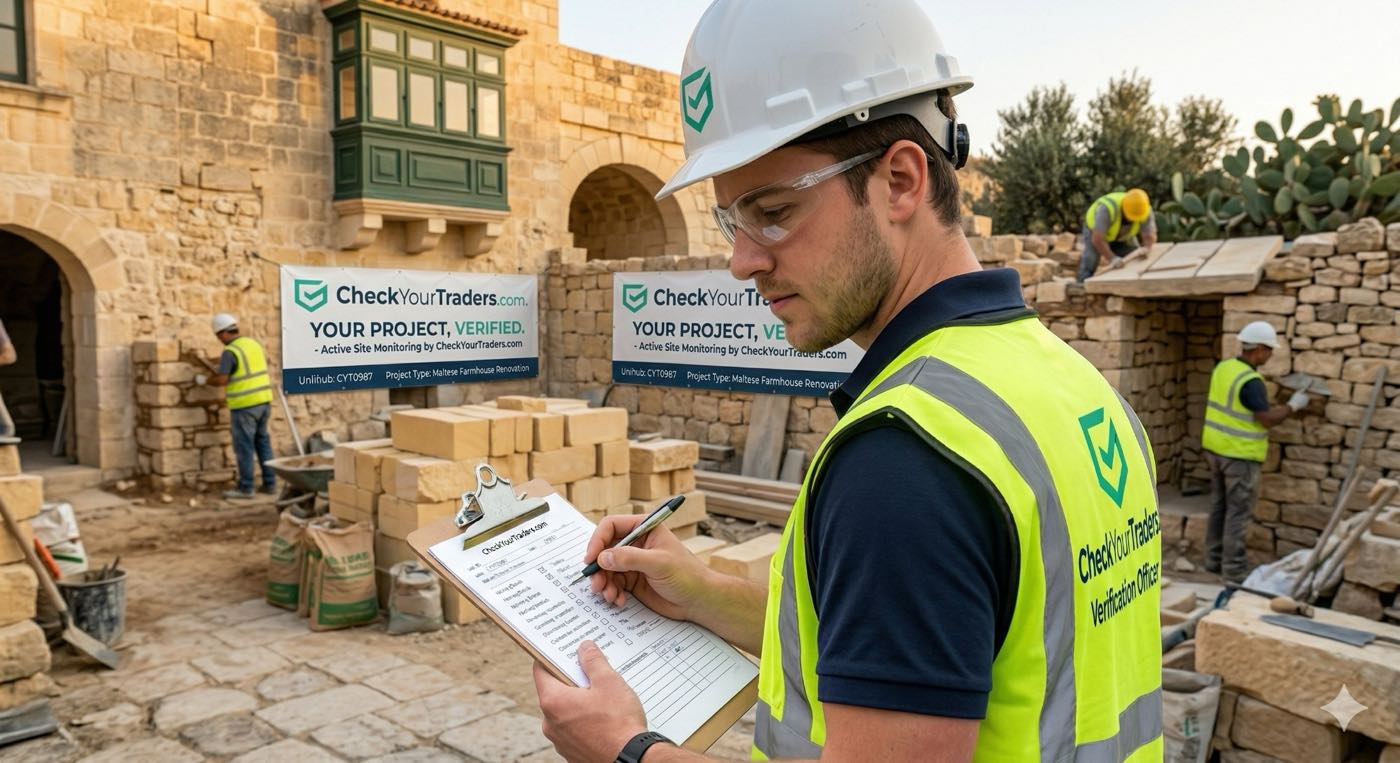
The Construction Management Site Regulations, S.L. 623.08 (LN 340 of 2022, amended by LN 142 of 2023), define "works" to expressly include building services works and finishing works. A fit-out is not outside the regime just because you are not knocking anything down.
Regulation 8 is the one that matters here. The client must appoint a site manager and notify the Building and Construction Authority before works start, giving the person's name, ID number and signed acceptance of the role. If no site manager is appointed, the client is deemed to be the site manager. A site manager cannot take on a perit's responsibilities unless they are themselves a perit under the Periti Act (Cap. 390).
Read that as a homeowner booking five trades directly: unless you appoint someone and file the notification, you are the site manager of your own flat. That is not a theoretical label. Regulation 6 puts on the client the duty to ensure the least possible nuisance in accordance with Schedules 1 to 4, and the Ninth Schedule attaches penalties to breaches — €500-€2,500 for Sunday or public holiday works, for example. Regulation 10 requires the client to deposit a bank guarantee with the BCA before the commencement notice, a minimum of €250, covering street restoration.
With a single contractor, the natural answer to "who is the site manager" is someone in that contractor's organisation, named and accepted in writing. With ten trades and no main contractor, there is no natural answer, and the regulation supplies one by default: you.
The Kamra tal-Periti made the same structural criticism back in 2019, when it noted that the rules of the day allowed the developer to be his own site manager, and that responsibility across the industry was fragmented.
Licensing covers less than you think
Contractor licensing arrived with LN 166 of 2023. Excavation, demolition and construction contractors must hold a licence, and from 1 July 2025 unlicensed operators in those categories had to stop work. By that date the licensing committee had approved 2,265 licences: 832 demolition, 509 excavation and 924 building. A licence is valid only once the fee is paid. Masons are separately licensed under existing law. Operating unlicensed after the deadline carries fines of up to €50,000 and up to six months' imprisonment.
What the sources do not say is whether a tiler, plasterer, gypsum installer, plumber or aperture fitter needs that licence at all. The regime as reported covers demolition, excavation and construction. So if you are self-managing a fit-out, "is this trade licensed?" may simply not be a question with an answer — which is different from the comfort of a UK scheme badge, and worth knowing before you assume one exists.
Skill cards sit in a similar half-state. One report described the Skill Card as mandatory for all workers on site. The Kamra tal-Periti's circular CIR 04/26 records that on 24 March 2026 the BCA emailed periti saying a skill card would be needed to enter sites from January 2027, while KTP's position is that the skill card regulations are still being finalised and not in force. At a meeting on 7 May 2026 the BCA CEO, Perit Roderick Bonnici, agreed that periti need not take the courses; the industry is still waiting for draft regulations, with courses expected at EQF Level 2. Do not plan around a card scheme that has not landed.
Insurance: what is actually required
Insurance is not a prerequisite for a contractor's licence. The ministry's position, as reported when the law passed, was that proof of insurance for each project is required before the BCA issues a Commencement Notice, under article 5(3). At that time there was no mandatory employer liability cover for contractors' workers.
Where works affect third-party property, a separate regime applies. LN 136 of 2019, in force since 25 June 2019, covers works affecting neighbouring property — excavation, demolition, building over or adjacent to third parties. There, the perit prepares the method statement, the contractor nominates a Site Technical Officer to ensure it is followed, and the developer must hold third-party insurance with an indemnity limit of at least €750,000 for the duration of the works, plus a bank guarantee of €3,000 per storey of each adjoining property for the first five storeys and €1,000 per additional storey, capped at €40,000, released within three months of the perit's completion notice.
A purely internal fit-out may not trigger any of that. But if your scope includes opening up a party wall, forming a new opening, or anything that touches a neighbour, the obligations in that list fall on the developer — in a self-managed job, you.
Defects: one throat or several
This is the quiet difference. With one contractor, a defect is his problem to locate and fix, whoever's subcontractor caused it. With separate trades, a leak behind new tiling is an argument between the plumber and the tiler, and you are the only person in the room with an interest in resolving it.
Maltese law does not make that argument easy to settle. The Kamra tal-Periti has pointed out that Civil Code article 1638 does not allocate blame between perit and contractor, leaving courts to decide case by case. That is a slow, expensive route for a shower tray.
Sequencing
No official guidance exists on coordinating trades on a domestic fit-out — we looked, and found none. What is structural is simply that finishing work is a chain: first fix before plaster, plaster before screed and tiling, apertures before final paint, kitchen after worktop template. Each handover is a date two different businesses must agree on, and in Malta each is also a delivery. In Gozo, each delivery is a ferry.
A main contractor absorbs those dependencies into one programme and one price. Self-managing means you hold every one of them, and a single trade slipping a week moves the next four.
When doing it yourself genuinely makes sense
It makes sense more often than turnkey contractors like to admit:
- Small or phased scopes. One bathroom, a kitchen replacement, repainting plus new apertures. There is little to sequence and the coordination premium buys you nothing.
- You live here and have time. Being on site daily is worth more than any contract clause. Remote owners rarely have this.
- You already know the trades. A plumber and tiler who have worked together before are effectively a small contractor without the margin.
- No structural or third-party element. Nothing that engages LN 136 of 2019, no party walls, no neighbours' property in play.
It makes less sense when the scope is a whole shell, when you are abroad, when the building is a condominium with rules and access windows to negotiate, or when the work touches a neighbour and the developer-side insurance and guarantee duties start applying to you personally.
The honest comparison
| One turnkey contractor | Booking trades yourself | |
|---|---|---|
| Site manager under S.L. 623.08 reg 8 | Appointed from the contractor's side, notified to BCA | Likely you, by default, unless you appoint someone |
| Reg 6 nuisance duty and Ninth Schedule penalties | Managed by the contractor in practice; client duty remains | Yours to manage day to day |
| Sequencing risk | Contractor's | Yours |
| Defect liability | One counterparty | Split; article 1638 does not pre-allocate blame |
| Cost | Includes coordination margin | No coordination margin, but your time is the cost |
| Licensing visibility | Ask for the licence category held | Unclear whether finishing trades are licensed at all |
Neither option removes the client's statutory duties. What a single contractor changes is who performs them, and who you argue with when something fails.
Common questions
- If I hire each trade myself, who is the site manager?
- Under the Construction Management Site Regulations (S.L. 623.08), the client must appoint a site manager and notify the Building and Construction Authority with the person's name, ID and signed acceptance before works start. If no one is appointed, the client is deemed to be the site manager. A homeowner booking trades directly therefore becomes the site manager by default unless they appoint someone else. A site manager cannot take on a perit's responsibilities unless they are a perit under the Periti Act.
- Do tilers, plasterers and plumbers need a contractor's licence in Malta?
- The 2023 licensing regime, introduced by LN 166 of 2023, covers demolition, excavation and construction contractors, and from 1 July 2025 unlicensed operators in those categories had to stop work. Masons are separately licensed under existing law. None of the sources we used states whether finishing trades such as tilers, plasterers, gypsum installers, plumbers or aperture installers fall within that licence. Treat it as unsettled and ask to see whatever registration the trade claims to hold.
- Does the finishing work on a shell count as 'works' under the site regulations?
- Yes. S.L. 623.08 defines 'works' to expressly include building services works and finishing works, so a fit-out is not automatically outside the regime simply because nothing structural is being touched.
- What happens if my trades work on a Sunday to catch up?
- The Ninth Schedule to S.L. 623.08 sets penalties for breaches, including €500-€2,500 for Sunday or public holiday works. Reg 6 also requires the client to ensure the least possible nuisance in line with Schedules 1 to 4. If you are the deemed site manager, that exposure is yours, not the tiler's.
What we could not establish
- Whether an internal fit-out with no structural work needs a perit, a commencement notice, or falls into a particular site type (e.g. Type C) under S.L. 623.08 is not stated plainly in any source we loaded.
- No source establishes whether finishing trades - tilers, plasterers, gypsum, electricians, plumbers, aperture installers - need a BCA contractor licence. The 2023 regime as reported covers demolition, excavation and construction only.
- Electricians are separately licensed through the energy and water regulator in Malta, but we have no source in this set establishing that, so the detail is not covered here.
- Licence validity is reported inconsistently: one source describes renewal every two years, others a three-year validity. We could not resolve it.
- The Building and Construction Authority's own FAQ PDF returned a 403 error when we tried to read it, so the regulator's plain-language position is not reflected here.
- Whether a client must appoint a project supervisor for health and safety, and whether a domestic client using a single contractor for the whole project is exempt (the rule often cited as S.L. 646.27 reg 8), is not established by any source in this set. Do not rely on it either way without checking the regulation itself.
- No official guidance was found on how a homeowner should coordinate multiple trades, or on who counts as 'client' when the homeowner books each trade directly. S.L. 623.08 implies the homeowner is the client and the default site manager, but it does not address the scenario expressly.
- No source covers normal contractor insurance for small fit-outs - contractors' all risks or public liability cover, limits or exclusions.
Sources
- MDA disappointed by 'weak and ineffective' new contractor licencing law (22 Jul 2023, Marianna Calleja) — MaltaToday · read 2026-10-26
- All operators in Malta's construction sector need a licence as of today (1 Jul 2025) — Business Now · read 2026-10-26
- Construction Management Site Regulations, S.L. 623.08 (LN 340 of 2022 as amended by LN 142 of 2023) — Legislation Malta · read 2026-10-26
- Avoidance of Damage to Third Party Property Regulations 2019 - An Overview (23 Jul 2019, DF Advocates) — Mondaq · read 2026-10-26
- CIR 04/26 Construction Industry Skill Card (20 Jul 2026) — Kamra tal-Periti · read 2026-10-26
- Press Release 08/2019 - The inadequacy of building and construction regulations (25 Apr 2019) — Kamra tal-Periti · read 2026-10-26
Drafted with Claude — claude-opus-5, then read, corrected and approved by Neil Bennett before publication. We do not publish anything a person has not read.
Want this costed properly?
The calculator gives you a budget in a minute. A survey gives you a fixed price.
Book a free survey