
Shell form: what you actually get, and what you do not
Shell form means a property sold without internal finishes, fixtures or services. There is no published standard for what is present at handover, so the only reliable answer is the one written into your own contract.
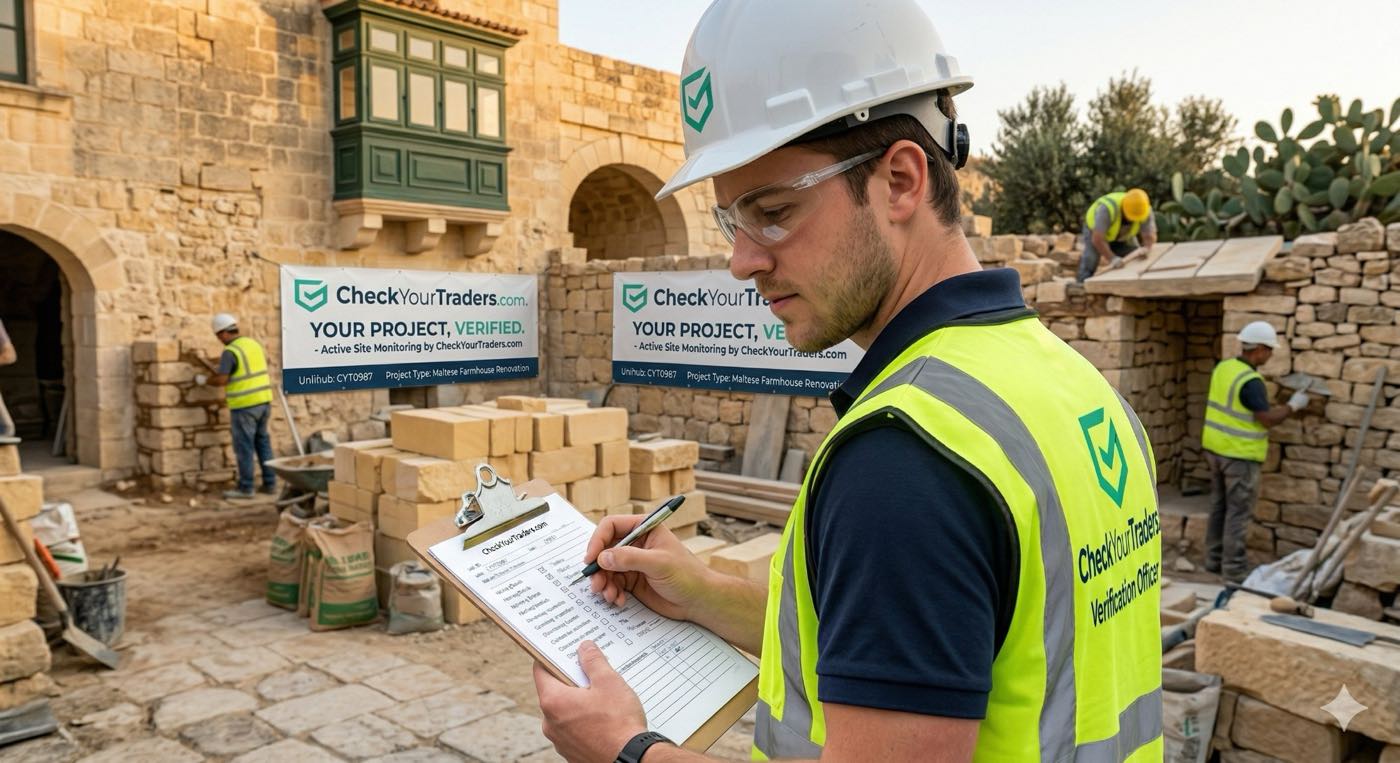
If you have bought in Britain, Ireland or most of the continent, a house is normally sold in a condition you can move into. Kitchen, bathrooms, floors, doors, plaster, paint — these come with the building, and a property lacking them reads as a project, a repossession, or something that went wrong. Malta does not work that way. Here, a very large share of property changes hands in shell form, and it is the ordinary product rather than the exception.
That difference in expectation is the single most common reason a finishing budget lands as a shock. The number itself is not unusual. The surprise is that anyone has to pay it at all.
What shell form means
Shell form describes a property sold unfinished: the structure is complete, but it comes without internal finishes, fixtures or services, and the buyer budgets separately to bring it to habitable condition (Darna).
That is the definition, and it is worth reading closely for what it does and does not do. It tells you the shape of the thing — walls and slab yes, the interior no. It does not tell you where the boundary falls on your particular property. Whether apertures are in, whether there is any plaster, whether services have been roughed in or merely stubbed at the boundary, whether the internal walls are even built — none of that is settled by the phrase itself.
Why there is no list in this article
You would expect, at this point, a table. Two columns, included and not included, and you tick your way down it.
We are not going to give you one, because it would be an invention. Shell form is a market convention, not a defined standard. No Maltese body publishes a handover schedule for it. Neither of the sources behind this article provides one — the glossary entry is a single sentence of general guidance that explicitly is not legal advice, and the agency piece is written for someone who has already bought and is getting on with the work. As far as we can establish, nobody publishes an authoritative version.
That absence is not a gap in our research. It is the finding. What "shell" means is set by each developer, project by project, and sometimes unit by unit within the same block. Two properties advertised in identical terms, on the same street, sold in the same month, can hand over in materially different conditions. A general list would be right often enough to be trusted and wrong often enough to be expensive.
So treat any confident inclusions table you find elsewhere — including from agents, including from other buyers on forums — as a description of somebody else's purchase. It may be a reasonable guide to the neighbourhood convention. It is not a description of yours.
The document that does answer it
The konvenju — the promise-of-sale agreement — and the specification attached to it are what actually govern your purchase. Whatever that document says the vendor is delivering is what the vendor is obliged to deliver. Whatever it omits, you are taking on.
This makes the reading of it the most valuable hour in the whole process. Concretely:
- Ask for the specification in writing, before signing, and go through it line by line rather than skimming for the headline items.
- For each element, establish which of three states it is in: present and finished, present in rough form, or absent entirely. The middle category is where budgets go wrong, because "the wiring is in" can mean anything from a full first fix to a single conduit.
- Establish who is responsible for each item, and by when. Vendor obligations that run past the promise of sale need to be written down.
- If something was agreed verbally on site — a wall moved, an aperture included, a screed level — get it into the document. After signing, the document is the agreement.
- Where the specification is silent, assume the item is yours. Silence is not an implied inclusion.
Your notary is the person to raise this with, and the promise-of-sale stage is when it is still cheap to raise.
The trade-off you are actually making
Shell is not a lesser version of a finished property. It is a different transaction with a different price.
When you buy something already finished, the additional money you pay over the shell price covers the previous owner's labour, the installation, and the goods themselves — the kitchen, the bathrooms, everything that had to be bought and fitted. In return, a finished property can be occupied almost immediately (RE/MAX Malta).
That is the whole trade. Buying shell defers the spend and hands you the specification decisions; buying finished converts the spend into somebody else's completed choices and gets you through the door now. Neither is the clever option in the abstract. It depends on whether you need to live there in three months, whether you care what the kitchen looks like, and whether you have the appetite to run — or pay someone to run — a finishing project in a country where you may not yet know the trades.
What the sources do not tell us is how large that gap typically is, in euro or as a share of purchase price. If an agent quotes you a rule of thumb for it, ask what it is based on.
Reading the calculator number properly
The figure the calculator produces is an estimate of the second half of the transaction: the money required to take a shell to habitable condition. It is not an extra, and it is not a penalty for having bought badly. It is the part of the purchase price that the vendor did not charge you.
The useful way to hold the two numbers together is to add them. Purchase price plus finishing cost is the comparable figure — the one you can set against a finished property on the same street, or against what you would have paid at home for something you could sleep in on completion day. Judged on the purchase price alone, Maltese property looks cheaper than it is. Judged on the total, the comparison is honest.
Two practical consequences follow. First, work out the finishing number before the konvenju, not after, because that is when you can still negotiate on price or on what the vendor delivers. Second, once you have the specification in front of you, the estimate becomes much sharper — a calculator working from a general assumption about shell condition is guessing at exactly the thing your contract has already decided.
Before you sign
- Understand that shell is normal here. Nothing has gone wrong.
- Do not rely on any general account of what shell includes, this one included.
- Get the specification in writing and read it against the three states: finished, rough, absent.
- Put verbal agreements into the document.
- Add the finishing estimate to the purchase price and compare on the total.
The question is never "what does shell form include". It is "what does my konvenju say it includes" — and that one has an answer.
Common questions
- Is shell form the same as an unfinished or abandoned building?
- No. Shell form describes a property sold with the structure complete but without internal finishes, fixtures or services, with the buyer budgeting separately to bring it to habitable condition. It is a normal way property changes hands in Malta, not a sign that something went wrong on site.
- Is there a standard list of what a shell property includes at handover?
- Not one that anybody publishes. Shell form is a market convention rather than a defined standard, and what is present varies between developers and between individual properties. The document that settles it for your purchase is the konvenju and its specification, so read that rather than a general list.
- Why is a finished property so much more expensive than the shell next door?
- Because you are paying for work already done. The gap covers the previous owner's labour, the installation, and the goods themselves — kitchen, bathrooms and the rest. In exchange, a finished property can be occupied almost immediately, which a shell cannot.
- What should I ask before signing the konvenju?
- Ask for the specification in writing and go through it item by item: what is present, what is roughed in, what is absent entirely, and who is responsible for each. Anything agreed verbally on site should appear in the document before you sign it, because after signing the document is what governs.
What we could not establish
- No Maltese body — regulator, notarial council or agency association — publishes an authoritative schedule of what a shell-form property contains at handover. Neither source provides one, and we could not find one.
- The sources do not establish whether services such as water, drainage or electrical first fix are typically present, partly present, or absent in shell-form sales.
- Neither source quantifies the price gap between shell and finished property, in absolute terms or as a proportion of purchase price.
- The sources say nothing about Planning Authority permit requirements for finishing works, about condominium rules governing works in apartment blocks, or about the practical effect of the Gozo ferry on deliveries and labour. These are real considerations, but they are outside what these sources support.
- The sources do not address whether shell-form conventions differ between new developments and resale, or between Malta and Gozo.
Sources
- Shell form — Malta property glossary — Darna · read 2026-09-02
- Finishing a Shell Form Property in Malta — RE/MAX Malta · read 2026-09-02
Drafted with Claude — claude-opus-5, then read, corrected and approved by Neil Bennett before publication. We do not publish anything a person has not read.
Want this costed properly?
The calculator gives you a budget in a minute. A survey gives you a fixed price.
Book a free survey