
The things we will not give you a price per square metre for
Our calculator publishes a rate for ten trades and refuses to publish one for eight other items. This page goes through the eight and explains, item by item, what each is actually priced from — heat load, a perit's drawings, the site, the condition of the stone — and why floor area is the wrong unit.
The homepage of this site is a budget calculator. It publishes a rate for ten trades, you put in your floor area, and it gives you a number. That is the whole proposition, and it only works if the rates are defensible. Which is why the more interesting list is the other one: the eight items in the same rate card that carry no published rate at all.
They are air conditioning, interior design, lighting and automation, structural and building work, landscaping, stonework, conservatories and house extensions.
This is not a hedge and it is not a way of keeping a conversation open. It is the same argument the calculator itself rests on. A rate is a claim that floor area predicts cost. For ten trades, it more or less does. For these eight, it does not — and each one fails for a different reason. Publishing a plausible-looking figure anyway would not be helpful vagueness. It would be a wrong number with a decimal point in it, which people take to the bank.
If you have just bought in shell form — which in Malta is simply how property is normally sold — you are trying to build a budget out of nothing. British and other EU buyers often arrive expecting a single fit-out cost per square foot, because that is the shorthand at home. Part of what follows is an explanation of why that shorthand breaks here.
Air conditioning: priced from heat load, not floor area
Air conditioning is sized from how much heat has to be moved out of a space. That depends on glazing area, orientation, exposure, ceiling height, insulation and how many rooms need independent control. Two apartments with the same floor area — one facing north with modest windows, one with a fully glazed south-west elevation — do not need the same equipment.
Then there is where the outdoor units go. In an apartment block that is a condominium question before it is an engineering one, and anything visible on a façade can become a Planning Authority question too. Neither of those is a function of your floor area. A per-m² rate for air conditioning would be right for one flat by coincidence and wrong for every other one.
Interior design: it is judgement, not quantity
Interior design does not have a unit of work in the way tiling does. What you are buying is decisions and documentation, and the scope ranges from a handful of finish choices to a fully drawn, fully specified scheme that other trades build from.
It also sits on the wrong side of the equation. Design does not follow the budget; it sets it. The same 120 m² gets a cheap outcome or an expensive one depending on what is specified, and the designer's fee is the smallest part of that difference. Pricing it per square metre would imply that the area determines the work, when in fact the brief does.
Lighting and automation: priced per point, not per plan
Lighting is priced by the number of points, circuits, fittings and control zones. Automation is priced by devices, the control system behind them and the logic joining them together. Two identical shells can be wired with a light and a switch per room, or with layered circuits, dimming, shading control and a panel that ties it all together. The floor area is the same in both. The work is not remotely the same.
Anything in the second category also has to be decided before first fix, because it is largely about cable routed inside walls. That is a scheduling constraint, not a pricing one — but it is the reason the question comes up early, before there is anything to price.
Structural and building work: priced from what a perit specifies
This is the clearest case. Structural work is designed by a perit, the warranted professional who carries responsibility for it. Until there are drawings, there is no specification; until there is a specification, there is nothing to measure. Steel, concrete, temporary support, what has to happen to neighbouring property, what the Planning Authority requires — all of it comes from that design.
A contractor who quotes structural work per square metre before the perit has drawn it is quoting a guess. Worse, it is a guess that nobody is professionally accountable for. This is the item to get moving first, because it also determines the layout everything else is fitted into.
Landscaping: priced from the site, not the building
Landscaping is the one item on the list that is not about the building at all. Its cost comes from the ground: how much of it there is, how you get materials onto it, whether it is soil or rock, what the level changes are, whether irrigation and drainage exist, and — for a roof terrace — what the structure can carry.
Internal floor area tells you none of that. A 200 m² house can have a metre-wide strip of yard or a large terraced garden with no vehicle access. Multiplying the internal area by a rate would produce two badly wrong numbers rather than one.
Stonework: priced from the condition of what is already there
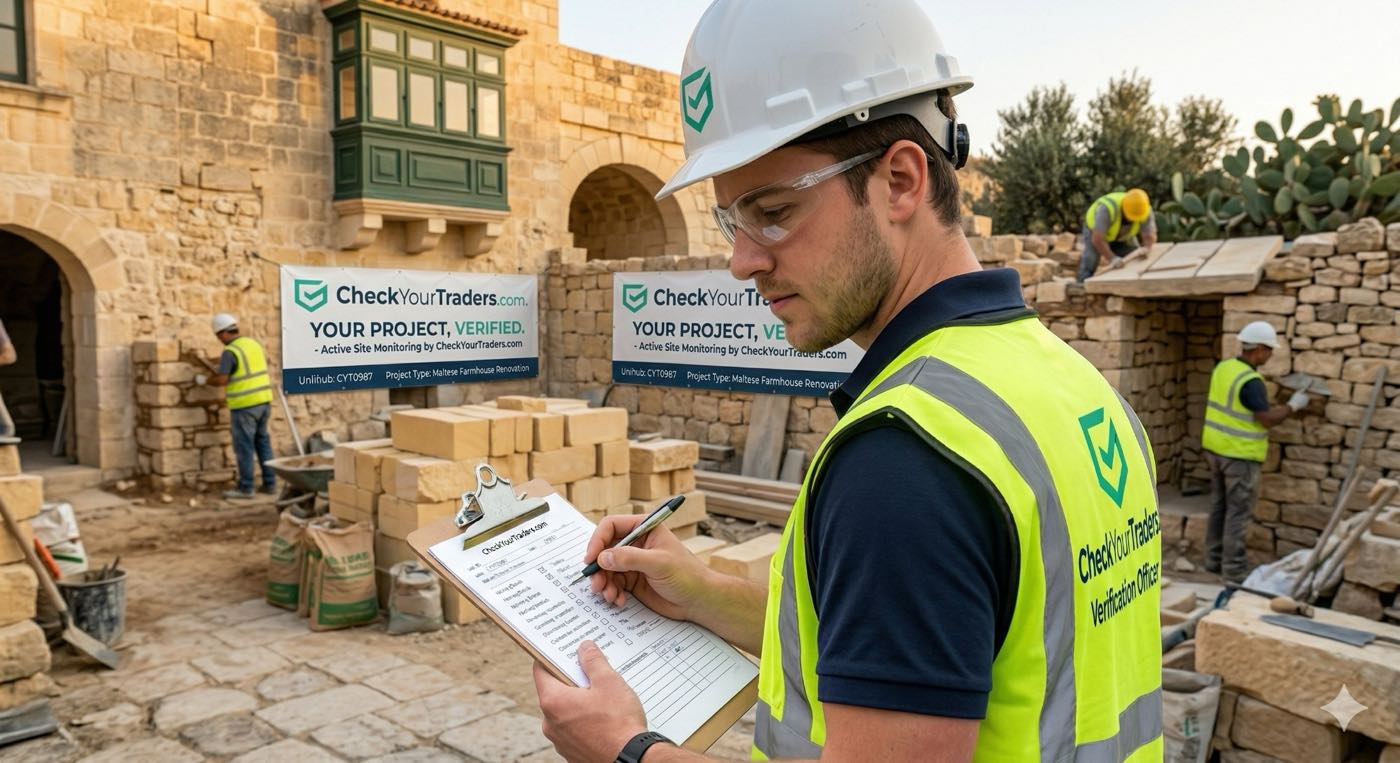
With stonework, the variable is not how much there is. It is what state it is in. Cleaning, re-pointing, cutting out and replacing individual courses, and rebuilding are all different operations at very different costs, and which ones apply is usually not fully known until render or paint comes off and the faces are exposed.
This makes stonework the item where a published rate would be most confidently quoted and most often wrong. The honest position is that it needs looking at, and that even after looking at it there is a discovery element.
Conservatories: a permission question before a price question
A conservatory is a new structure. Whether you can have one, how big, and in what form is determined by the Planning Authority, and in an apartment or a shared block by the condominium as well. That comes before anyone discusses aluminium sections and glazing specification.
The floor area involved is also usually small, which means fixed costs — structure, glass, opening mechanisms, weathering, access to get materials up — dominate. Dividing by a handful of square metres produces an enormous and meaningless rate.
House extensions: not a finish, a project
An extension has everything the previous items have and one thing of its own: the junction with the existing building. It needs a perit, it needs permission, and the expensive and uncertain part is where the new work meets the old — foundations, structure, weathering, services, and whatever is discovered when the existing wall is opened up.
Quoting an extension by its own square metres hides all of that, and hides the fact that the permitting timeline is often the longest item in the programme.
What to do with this list instead
The practical use of these eight items is as named blanks in your budget rather than absent lines.
- Get structural resolved first. A perit's drawings unlock the specification for structural work and stabilise the layout every other trade is quoting against.
- Use the calculator for the ten trades that carry a rate. That is the part of the job floor area genuinely predicts, and it is the majority of a standard shell finish.
- Treat the eight as separately quoted items with their own inputs: a heat load calculation, a lighting schedule, a site visit, a stone survey, a planning position.
- Keep them visible in the total. A budget that silently omits air conditioning and landscaping is not a lower budget. It is the same budget with two lines missing.
A number you cannot stand behind is worse than no number, because no number prompts a question and a bad number stops one. That is why the calculator publishes ten rates rather than eighteen.
Common questions
- Why does the calculator price my tiling but not my air conditioning?
- Because a square metre of floor is the real unit of work for tiling and not for air conditioning. Air conditioning is sized from heat load — glazing, orientation, exposure, ceiling height, how many rooms need independent control and where the condensers can legally go. Two flats of identical floor area can need materially different equipment, so a per-square-metre figure would be right for one and wrong for the other.
- Does no published rate mean you won't do the work?
- No. It means the item cannot be costed from floor area alone, so it is quoted from something else: a heat load calculation, a perit's drawings, a site visit, a survey of the existing stone. The rate card marks eight items this way — air conditioning, interior design, lighting and automation, structural and building work, landscaping, stonework, conservatories and house extensions.
- Can you at least give me a rough figure to put in my budget?
- Not a per-square-metre one, because a rough figure presented as a rate gets treated as a rate. It gets taken to the bank, compared against other quotes and remembered when the real number arrives. The honest version is to leave these eight items as named blanks in your budget and fill them in when the inputs that actually drive them exist.
- What should I get priced first if I've bought in shell form?
- Anything structural. Structural and building work is priced from what a perit specifies, and a perit's drawings also determine what the other trades are working inside. Until those exist, the layout, the openings and sometimes the permitting status of what you want are all still moving, and every other quote you collect is provisional.
What we could not establish
- The sources establish which items carry no published rate, not what those items typically cost in Malta. No benchmark range is published here for any of the eight.
- The rate card does not establish a rule for Gozo — whether ferry-borne deliveries change any published rate, or by how much.
- Nothing in the sources establishes perit fees, Planning Authority application costs or condominium approval processes, all of which sit upstream of several of the eight items.
- The rate card does not state what is or is not included within each of the ten published rates; that detail is not reproducible from the source used here.
Sources
- Turnkey.mt budget calculator rate card (js/main.js) — Turnkey.mt · read 2026-09-02
Drafted with Claude — claude-opus-5, then read, corrected and approved by Neil Bennett before publication. We do not publish anything a person has not read.
Want this costed properly?
The calculator gives you a budget in a minute. A survey gives you a fixed price.
Book a free survey